

The short version
Google’s Veo 2 cost “more than 10x” its rivals, fal’s Burkay Gür said, and “there is essentially infinite demand”.
He described new work on a pricier model, and fal’s archived page shows $2.50 where he recalled $5.
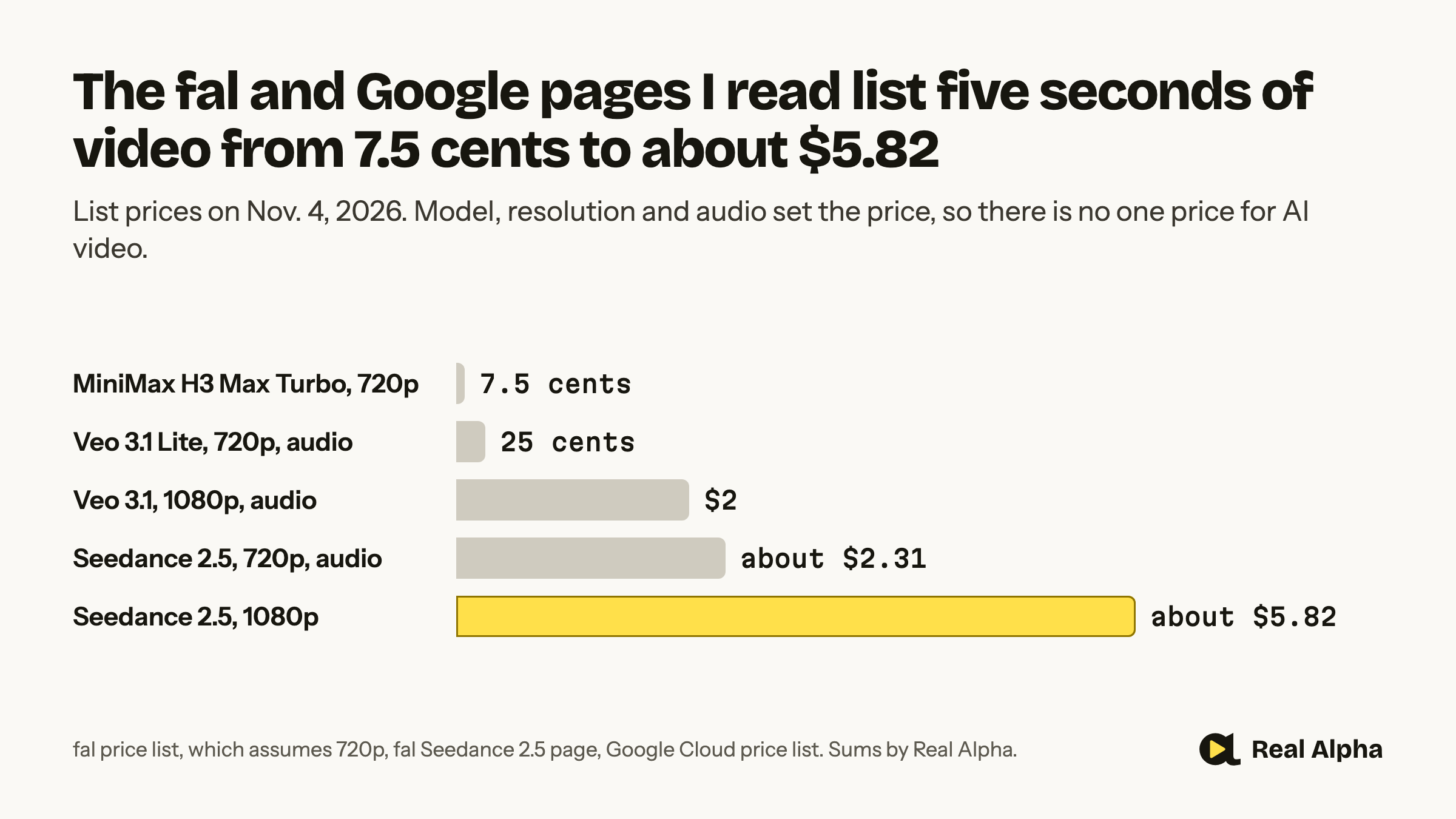
Price video by the job, since fal pages I read run from 7.5 cents to about $5.82 for five seconds.
A few times below open the interview at that second.
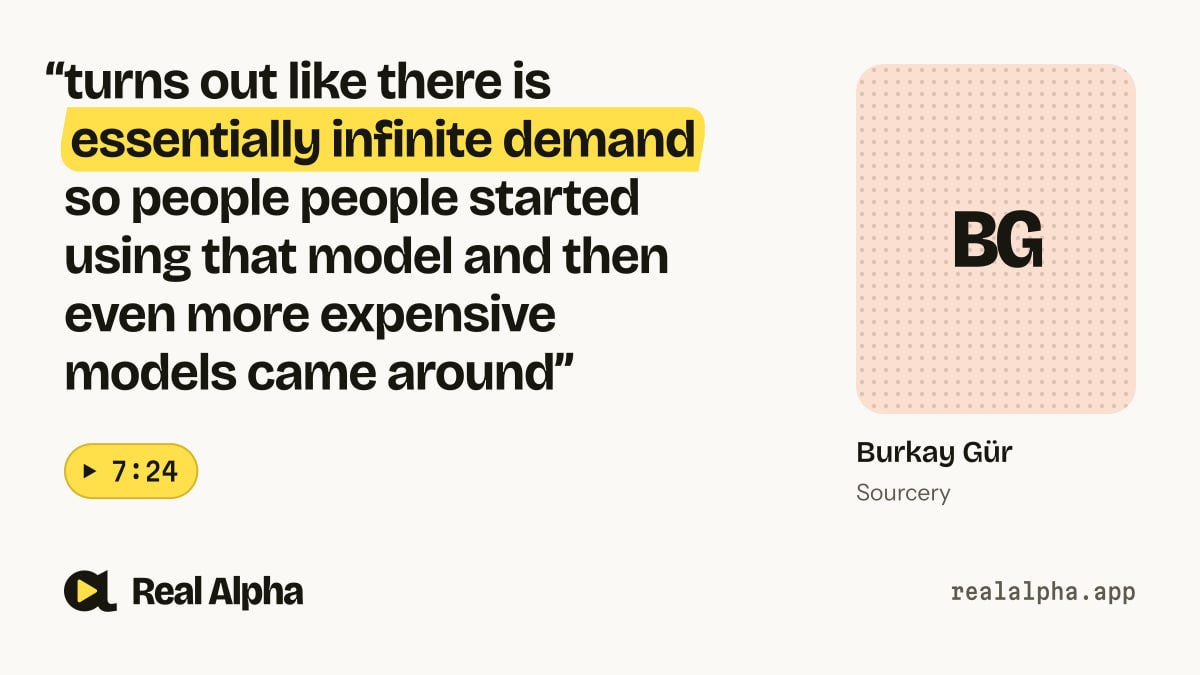
A clip from Google’s Veo 2 cost “more than 10x” what rival video models charged, Burkay Gür said on Sourcery. He runs fal, which sells the compute behind such clips, and he said “there is essentially infinite demand” 7:33.
If you price an AI product or buy generated media, that story says charge more or budget more. I read it differently. A different product found different work, and the job decides who pays.
Below is what fal’s own price pages show, why a pricier clip can still pay and two questions to ask.
The episode went up Nov. 3, and its title puts fal’s latest rounds at $1.65 billion. So treat every number here as a seller’s. Its founders, Gür and Gorkem Yurtseven, gave no revenue total or clip count.
Gür’s $5 clip was a pricier new model finding new work
Kling and MiniMax. He said Veo 2 came out last year, when Kling was probably one of the best video models, alongside MiniMax. They started at “let’s say 40 cents” per five-second video, he said, then settled at maybe 30 cents.
Veo 2. Then Veo 2 arrived at what he recalled as $5 for five seconds. People paid anyway, he said, and then “even more expensive models came around”.
He names no model whose price rose, though he says “everything’s getting more expensive over time”. On fal’s pages, Kling 1.6’s standard tier did rise. It went from 4.5 cents a second in April 2025 to 5.6 cents now, with no reason given.
A far pricier clip appeared beside the old ones and, on his telling, found work they couldn’t do. I read most of that as a shift in the mix, and it’s easy to misread as pricing power.
Gür saw more professional uses 7:48, in ads, marketing and “actually like movie production”. His reason was quality, and demand that other models “weren’t able to actually capture”.
Later a founder said Hollywood had reached “a meaningful percentage of our revenue”. The same founder said AI “barely made any content that’s worthwhile” there.
fal’s archived page shows $2.50, and the multiple depends on the comparison
The dollars don’t match fal’s page.
A copy archived in April 2025 lists Veo 2 at $2.50 for five seconds, plus 50 cents per extra second.
Google’s price list still shows Veo 2 at the same $0.50.
Captures from Feb. 21, 2025 to July 2026 all work out to 50 cents a second.
The first sold eight seconds for $4, and he gave no source for his $5.
His “more than 10x” depends on the comparison 7:21. Against his own 30 cents, $2.50 is about 8 times.
The April 2025 Kling 1.6 page listed its standard tier at 4.5 cents a second, or 22.5 cents a clip. Against that, $2.50 is about 11 times. Kling’s pro tier, at 9.5 cents a second, makes 47.5 cents a clip, or about 5 times.
Still, the jump was real, at half the dollars he gave. If you repeat this story to your team, say several times the price and drop the $5.
fal pages I read run from 7.5 cents to about $5.82
“the quality is going up, prices are going up”
Burkay Gür’s summary on Sourcery
At the top, fal’s page for ByteDance’s Seedance 2.5 backs him. He named that model 8:42.
Its price text gives roughly $1.164 a second at 1080p, or about $5.82 for five seconds. Its overview says up to 720p.
Lower down, “everything’s getting more expensive” fails. The price list on fal has MiniMax’s H3 Max Turbo at $0.015 a second, or 7.5 cents for five seconds.
The list assumes 720p. There, fal’s Seedance page gives about $2.31, so the gap is about 31 times.
Google’s list shows the same shape. Veo 3.1 Lite with audio is 25 cents for five seconds, if its price unit means a second. Nothing there says it matches Veo 2 on quality.
On these lists I see a ladder that keeps adding rungs in both directions. The premium sits on the newest top rung, and a 25-cent clip now sits under Google’s $2 one.
Clip price shrinks next to the media budget it serves
So why pay several times more? I think the answer sits in the ad budget. Yurtseven, fal’s CTO, said a long ad needn’t be one continuous generation, since “you can do fast small cuts” 10:57.
Take a 60-second ad cut from 12 five-second clips. At fal’s $2.50, that is $30, against $3.60 at Gür’s 30 cents. Allow 20 takes per clip, my assumption, and it is $600 against $72.
Now set that beside the media. Hector Serrano of Wispr Flow said an ad “will be dead” after about $100,000 in spend.
I’d guess most ads never get there, since his library might hold about 5,000 lifetime ads. If one in 10 does, my guess, $600 becomes $6,000 per winner, or 6%, and $72 becomes $720, or 0.7%.
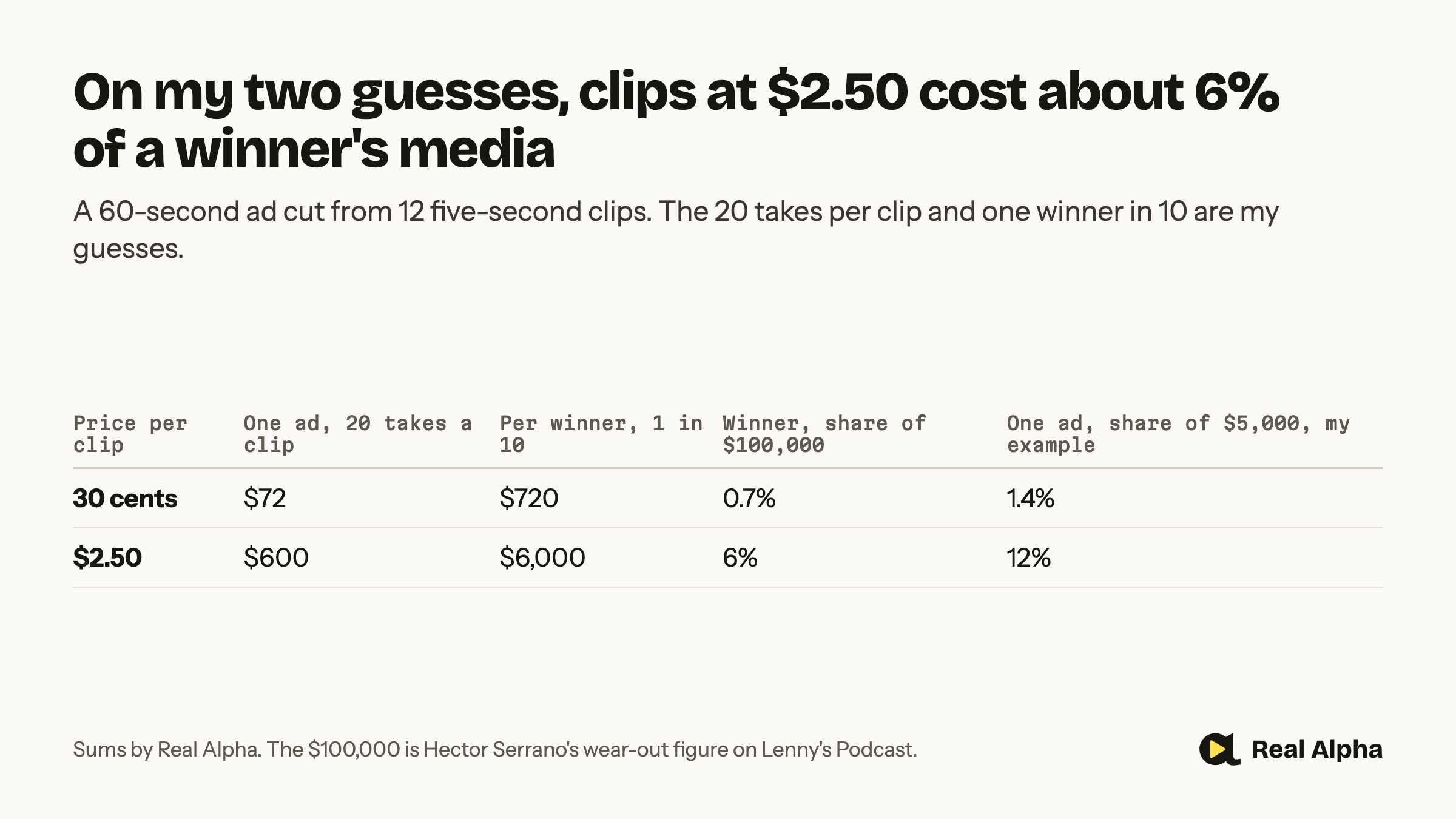
He meant Wispr Flow’s ads at its spend, and he says AI shouldn’t touch final creative yet. I borrow his number as a scale only. I think budgets that size could absorb the gap, though no source shows Veo 2’s buyers had them.
On a $5,000 test budget, my example, one $600 ad is 12% and one $72 ad is 1.4%.
So I’d expect top-rung spend to cluster where media budgets are large. A split showing small accounts leading the top rung would prove me wrong.
Buyers are moving. Nearly two in three use generative AI for video creative, says IAB’s 2026 video report. IAB is the ad trade’s own group, and its release gives no sample size.
Studies split on viewers. Of 104 ad executives in IAB’s AI Ad Gap study, 82% thought young consumers felt positive about AI ads. Of 505 such consumers, 45% did.
FreeWheel’s TV ad survey, per PPC Land, points the other way. Of 226 buyers, 48% assumed viewers find AI creative off-putting. Of 2,496 US adults, 10% said they disliked the AI ads they’d seen. FreeWheel sells ad tech.
So test the homemade-style ads Yurtseven calls throwaway when they fail on your own viewers.
Essentially infinite demand didn’t save Sora
Gür reached for the word infinite twice. On fal, he said, Sora saw “huge growth” in its last three months before OpenAI took it down. “There’s like infinite volume here, essentially,” he recalled 9:19.
He called the cause a rumor, that there wasn’t enough compute, and added that Sora was expensive to run. Sam Altman was plainer on Relentless in July.
“it was more important to put the compute and the energy into coding agents”
Sam Altman of OpenAI
Yurtseven said that unless someone invests ahead, “all the compute is going to go to coding agents”. That is the limit I’d put on the word infinite. A video clip competes with a coding agent for the same chips, and volume alone doesn’t decide it.
Appfigures data in TechCrunch had Sora’s app downloads down 45% in January, to about 1.2 million. Those are app estimates, so I’d ask which Sora the word infinite covers.
Yurtseven also said margins are “close to zero in the application layer” 1:01:12, and fal sells to that layer. If he’s right, I’d question how durable part of that demand is.
Price the job, and budget by the finished ad
If you sell an AI product, don’t read this as room to raise your current price. Gür’s account shows a premium where better output opened new work. Before you add a top tier, name the buyer and the job it opens.
If you resell generated media on a flat plan, check which rungs your heaviest users run. A spread of 31 times inside one plan can erase a margin that Yurtseven already puts near zero.
If you buy generated video, stop comparing per clip. Track takes per usable clip, cost per finished ad and that cost as a share of the media behind it. Test prompts at one model’s low settings, then budget fresh takes at its high ones.
Keep a second model working in your pipeline, because Sora left despite the volume Gür described. Ask each vendor how much notice you get before a model is retired.
I think the premium above a cheap rung loses its job once that rung is good enough for paid ads.
Two questions for anyone quoting you demand like this
How many clips sold at each price, and how many buyers came back the next quarter?
What share of spend comes from the top 10 accounts, and what share is hobby use?
Watch the 5 minutes where Gür gives the prices.
Where it comes from
The moments cut from this episode
Higher video prices are revealing deeper professional demand, from 4:33
AI ads can improve through rapid creative testing, from 9:22
fal pivoted from Python infrastructure to image models, from 13:22
Model launches now require compute partnerships, from 37:32
Hollywood adoption is slower than the AI debate suggests, from 48:49
What other people said
Ads can wear out after about $100,000 in spend, Hector Serrano, Lenny’s Podcast, Nov. 1, 2026
OpenAI kills successful projects when compute has a better use, Sam Altman, Relentless, July 25, 2026
The pages outside the episode
fal’s Veo 2 page, the link opens the copy archived April 4, 2025, and copies from Feb. 21, 2025 to July 12, 2026 were read
fal’s Kling 1.6 standard page, archived April 28, 2025, and read live Nov. 4, 2026
fal’s price list, read Nov. 4, 2026
fal’s Seedance 2.5 page, read Nov. 4, 2026
Google Cloud’s price list for Vertex AI, read Nov. 4, 2026
Business outcomes are just the beginning, IAB, July 14, 2026
The AI Ad Gap Widens, IAB with Sonata Insights, Jan. 15, 2026
OpenAI’s Sora app is struggling after its stellar launch, TechCrunch, Jan. 29, 2026
fal’s Kling 1.6 pro page, archived April 25, 2025
FreeWheel finds 48% of buyers overrate viewer dislike of AI ads, PPC Land, Sept. 5, 2026
The episode’s transcript is a machine’s and doesn’t name speakers. Who said what comes from the turns and muted looks at the frames.
Real Alpha sends the best minutes from the week’s long AI interviews, twice a week, free. Get it here.