

The short version
AWS capacity for 2027 is largely sold out, even with $220 billion of capex this year, Andy Jassy said.
He tied that to big chunks, and put no number on the on-demand slice left for others.
If you buy compute, get limits and price terms in writing, and check January’s update to AWS’s GPU reservation prices.
A few times below open the interview at that second.
Amazon expects about $220 billion of capex this year and still can’t meet demand, Andy Jassy said on a16z’s podcast. AWS capacity for 2026 is sold out and 2027 is “largely sold out,” he said 24:50. He added that “a good chunk of 28” is gone too.
If you buy compute, this bears on your limits, your contract length and your rates. Amazon sells that compute, so these are a seller’s words. Below is what he said, who holds that capacity and four questions for your next cloud renewal.
I read the sold-out line as narrower than it sounds, a statement about big blocks. The slice a founder buys from has no stated size and no price promise.
Ben Horowitz co-hosted. He co-founded a16z, which backs AI startups and built Oxygen, a GPU program for them. An All-In host called him “a big OpenAI investor”.
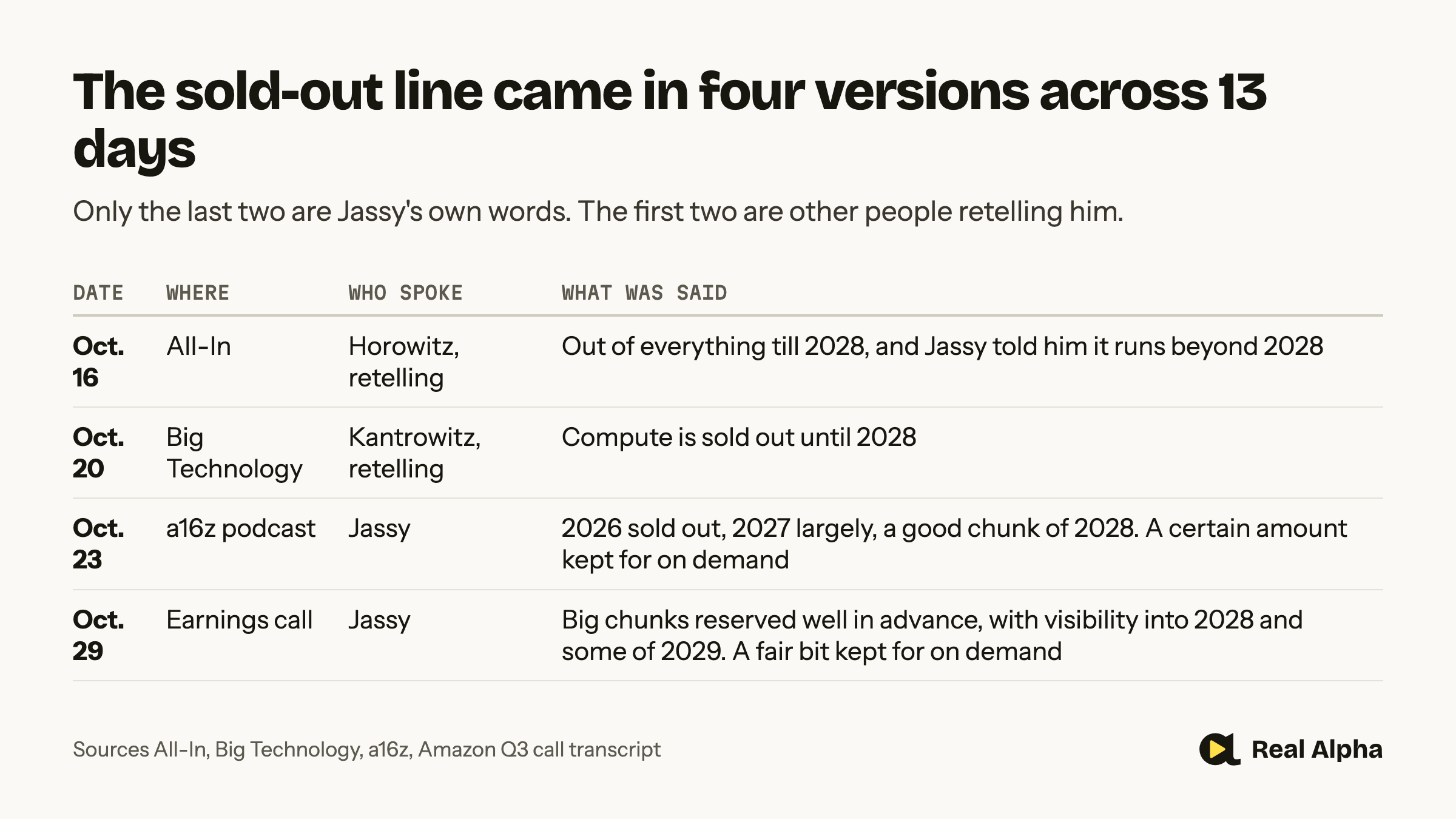
Jassy says sold out means big chunks, with some kept back
The line reached people before the episode did. Jassy’s own version, posted Oct. 23, is narrower.
“a certain amount for on demand”
Andy Jassy on what AWS keeps back on Bedrock, its inference service, and on EC2, its rented servers
He tied it to “all the big chunks.” On the Oct. 29 earnings call he put those chunks at hundreds of megawatts, sometimes up to a gigawatt.
Few readers here buy a hundred megawatts. So the sold-out line isn’t strictly about your order.
The carve-out went from “a certain amount” 24:59 to “a fair bit” with investors. They also heard customers will “have plenty of capacity.” None of that is a number.
Amazon’s $220 billion covers warehouses and AWS, with no AI split
The episode’s title calls this an AI buildout. Jassy’s words were broader, “about $220 billion of CapEx” for 2026 13:17.
On the Oct. 29 call he said most of it is for AWS. Amazon’s 10-Q says capex also pays for “additional capacity to support our fulfillment network.” That means warehouses.
So don’t read $220 billion as supply headed your way. An unknown part is AI compute, and much of that already has buyers.
Two labs account for at least $238 billion of announced commitments
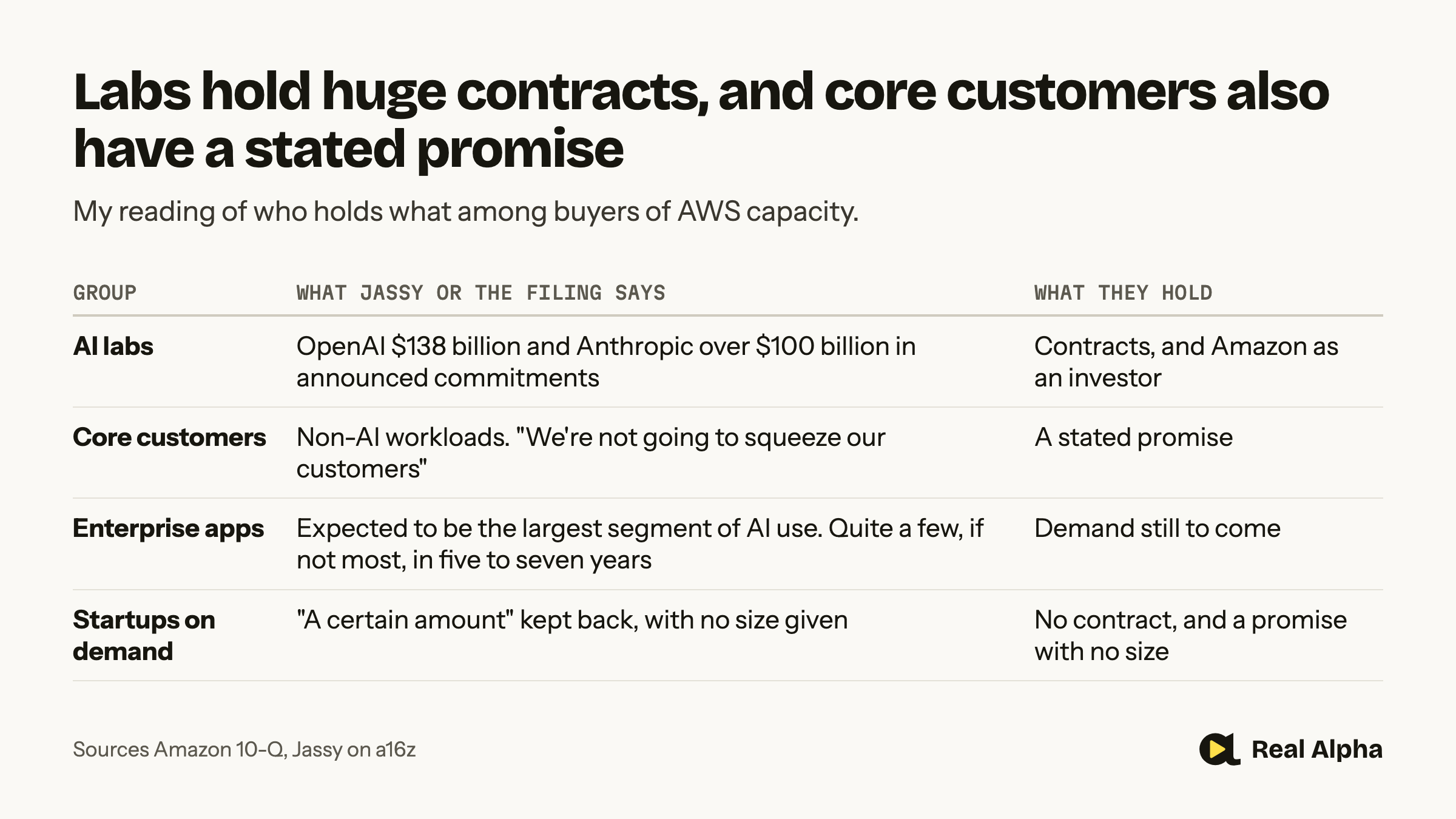
Amazon’s 10-Q shows the size. OpenAI’s $38 billion commitment grew by $100 billion over eight years, to $138 billion.
Anthropic’s grew by “more than $100.0 billion over 10.0 years.” Together that is at least $238 billion, my sum. Amazon’s backlog, mostly AWS, was about $578 billion on Sept. 30.
That $238 billion is about 41% of the backlog, my sum again, and Jassy called the backlog “well diversified.” The comparison is rough. Amazon doesn’t say how much of those commitments sits in that backlog, so the real share could differ.
UBP, a private bank, puts the share across the four largest clouds at roughly 40% of $2.3 trillion. It shows no method, and the two labs publish no accounts.
“consuming gobs and gobs of compute”
Andy Jassy, who described demand as a barbell with AI labs at one end
These buyers are also Amazon’s investments. A host put the stakes at about $18 billion in Anthropic and $50 billion in OpenAI. The 10-Q backs both.
Smaller buyers can see the reverse. Startups may owe 30% to 100% up front on three-to-five-year deals, Evan Conrad of SF Compute said. Conrad sells compute himself, and he was describing clouds that borrow to build clusters, without naming AWS.
In our machine transcript of an hour on a venture firm’s show, startups came up only on how they build 41:10. Nobody asked how they get capacity.
Jassy’s squeeze promise covers core customers and names no price
Horowitz asked if labs paying “almost anything” creates pressure to “buy out the old guys” and resell to them. Jassy said he doesn’t think of it quite that way.
“We’re not going to squeeze our customers”
Andy Jassy, Amazon’s CEO
AWS will make sure they “can scale,” he said 26:50. He was talking about core customers, which he defined as non-AI, running their main applications on AWS.
He did add AI customers, but as a goal. The job is as much capacity as possible, in a way that’s “sustainably economically for us as well”.
He compared it to helping customers cut costs in the pandemic. He knew that would cut revenue in the short and medium term. He named no price commitment here.
On the call he said Bedrock on AWS’s own chips helps “keep prices as low as possible for customers.” I read “can scale” as mostly about capacity, with new bookings at the going rate.
Capacity Blocks are AWS’s short GPU reservations. AWS’s price page says their rates are “updated regularly based on trends in supply and demand.”
The Register reported the rate for eight Nvidia H200 chips going from $34.61 to $39.80 an hour in January. AWS’s page now shows $54.924. That is up about 59% in about 10 months, my sum.
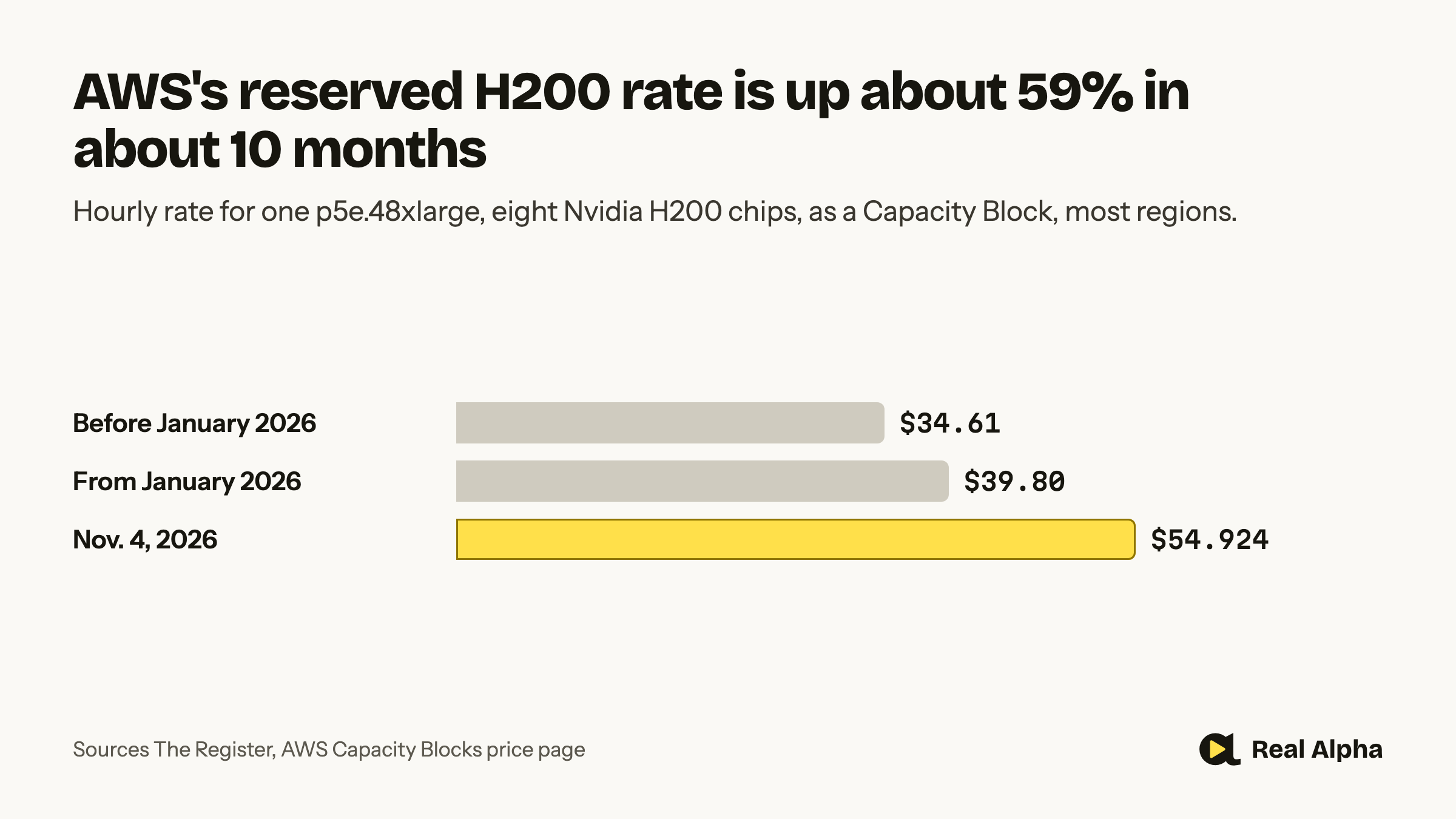
This covers one reservation product, and the page says nothing about on-demand rates or Bedrock tokens. Capacity Blocks are AI capacity, so this rise doesn’t test his promise to non-AI core customers.
The Register noted an earlier announcement of “up to 45% price reductions” on on-demand GPU instances. That was about seven months before January’s rise.
“has gone up every day”
Gavin Baker of Atreides on renting almost any GPU in October. His firm has stakes in Crusoe, a GPU cloud, and in his data source
Silicon Data, which Baker’s firm backs, sells GPU price data. Its H100 index for smaller clouds and marketplaces went from $2.82 on Oct. 6 to $2.92 on Oct. 31. It had some down days, and that’s about 3.5% ($0.10 ÷ $2.82).
Its separate reading for the big clouds went from $7.15 to $7.14. So rents rose in one market and sat flat in the other, on one older chip.
Jassy’s five-year deals run about two years past server break-even
Jassy laid out the cash cycle. Servers tend to break even in about three years, with useful lives of five to six years. Most deals run about five years, he said 14:58.
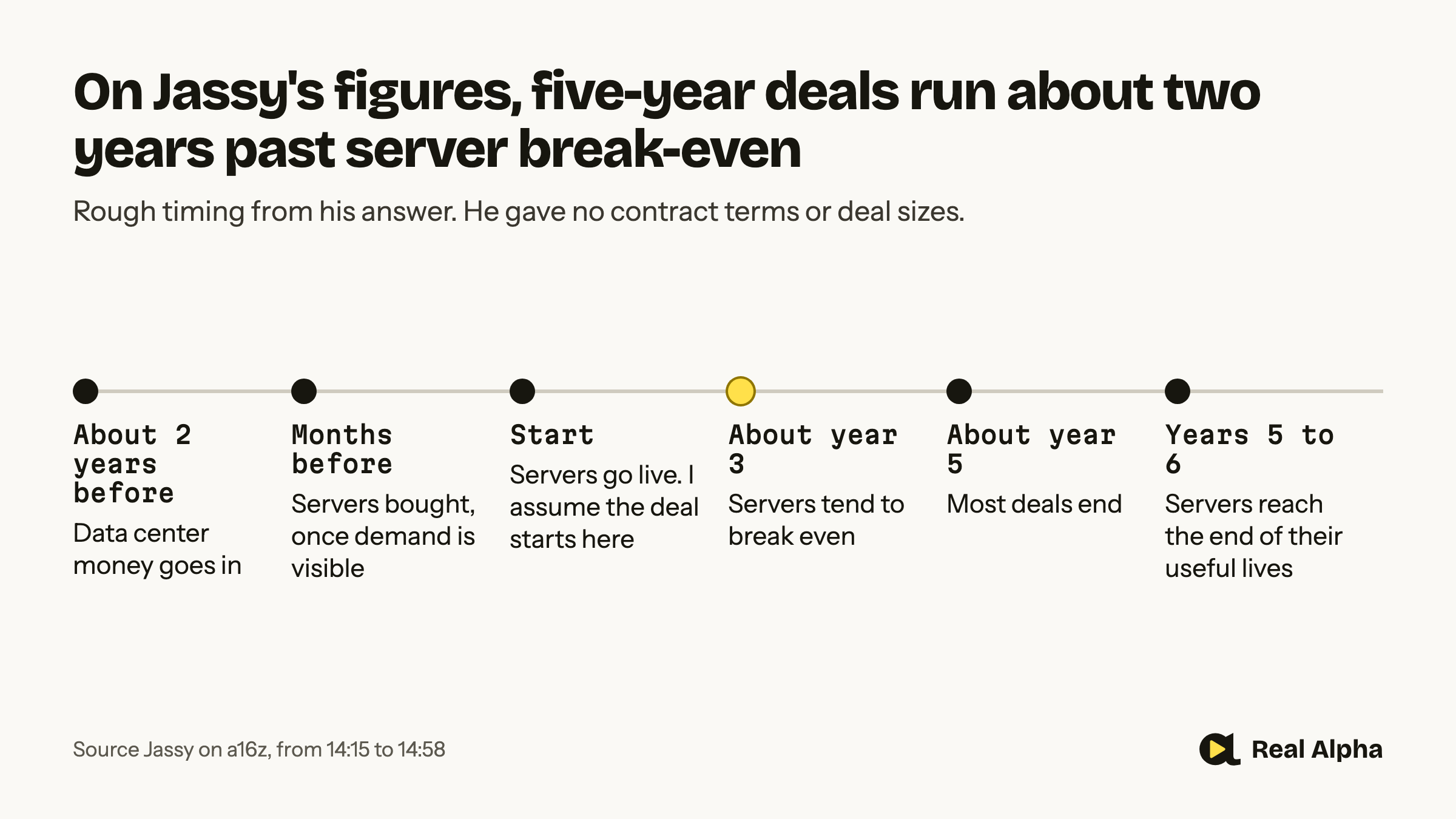
Run the sum on his figures. If servers break even around year 3 of a five-year deal, about two years of payments follow. On the call he said break-even keeps getting shorter, so that gap would grow.
With a fixed price, those later years can go either way for a buyer.
Jassy calls inference an order of magnitude too expensive, with no date
“still an order of magnitude too expensive, in my opinion”
Andy Jassy on inference, for pervasive use
He gave no schedule. On the call he said he thinks costs will keep coming down meaningfully.
Pick the compute risk you hold, then get it in writing
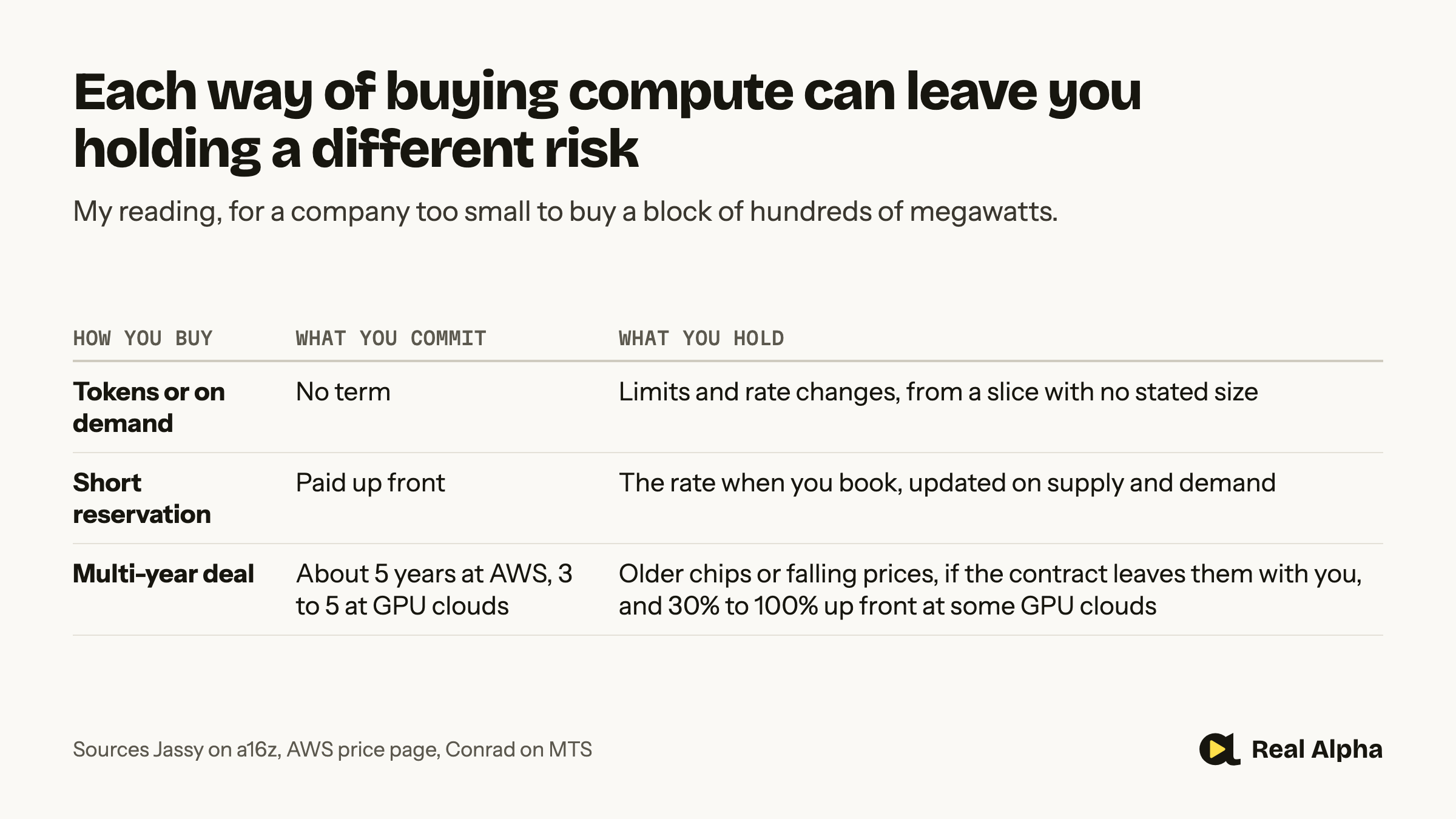
If you rent or run GPUs, measure use before you book more. In VentureBeat’s reader surveys, 79% of 218 who reported use said theirs were busy half the time or less. Among 32 on their own clusters or self-managed stacks, it was 56%. They were self-selected readers and panel respondents at firms of 100 or more.
If you buy Bedrock tokens or EC2 on demand, look up your limits in Service Quotas. Request your peak increase there if that quota is adjustable. AWS can deny it. “A certain amount” isn’t a contract term. Run a peak-load test this quarter, since that slice has no published size.
If you book short reservations, check your timing. AWS charges “the prevailing rate at the time of purchase,” even if the block starts after a price change.
If you’re pitched a long contract, price the last two years separately. Servers tend to have broken even by then. That covers servers and networking rather than buildings, and Jassy said on the call it varies. Ask about swapping chips, subletting capacity and what happens if list prices fall.
If you’re choosing a cloud, ask whose capacity it plans before yours. Jassy’s answer started with core customers. Test your workload on a second supplier this quarter, since Jassy expects supply constraints for several years 27:18.
Watch January’s Capacity Block update and whether Amazon sizes what’s left
AWS’s next Capacity Block update is due in January 2027, the first dated test of whether these rises continue. The page doesn’t say which way. Amazon’s filing expects capex to “meaningfully increase in 2027,” and it still gives no AI split.
This reading would be wrong if labs pull back and big blocks come free. On-demand would loosen, and long deals would look expensive.
Four questions for your next cloud renewal
What raises my limit during a shortage
Does my price hold for the term, or move with supply and demand like Capacity Blocks
In years 4 and 5, can I swap older chips or sublet them
Whose capacity gets planned before mine
Forward this to the person who signs your cloud contract.
Watch the 7 minutes where he says what’s sold out.
Where it comes from
The moments cut from this episode
Amazon chose customer speed over efficiency during the pandemic buildout, from 5:58
Customer demand guides Amazon’s AI infrastructure spending, from 10:36
Jassy says data centers are essential infrastructure for the U.S, from 16:08
AI demand is concentrated, but AWS won’t displace core customers, from 20:43
Annapurna gave AWS a path to custom chips and lower inference costs, from 27:50
AI will push companies toward smaller teams and faster security, from 36:57
Amazon is rebuilding Alexa and other products around AI, from 46:07
Amazon pursues new businesses with dedicated teams and clear hurdles, from 56:14
Other people’s moments used here
LoudCloud’s bandwidth contracts show infrastructure risk, Ben Horowitz on All-In, Oct. 16, 2026
GPU supply is tight despite the capacity coming online, Gavin Baker on TBPN, Oct. 27, 2026
Compute prepayments are pricing startups out of clusters, Evan Conrad on MTS, Oct. 28, 2026
The pages outside the episode
Amazon’s Form 10-Q for the third quarter of 2026, filed Oct. 30, 2026
Amazon’s Q3 2026 earnings call, Oct. 29, 2026, as transcribed by The Singju Post
Amazon EC2 Capacity Blocks for ML pricing, AWS, read Nov. 4, 2026
AWS raises GPU prices 15% on a Saturday, The Register, Jan. 5, 2026
Financing the AI build-out, Filipe Alves da Silva, UBP, Sept. 16, 2026
H100 Rental Price Index, Silicon Data, read Nov. 4, 2026
AI bubble update, VentureBeat, Oct. 23, 2026
What is Service Quotas?, AWS, read Nov. 4, 2026
Real Alpha sends the best minutes from the week’s long AI interviews, twice a week, free. Get it here.